Hand and Foot Rules: Deal, Books, Picking Up the Foot, Going Out and Scoring
Hand and Foot is a canasta-style partnership game where each player gets 2 stacks of cards: a hand to play first and a foot to play once the hand is gone. Partners build melds of the same rank into 7-card piles (often called books). To go out, a partnership needs 2 clean piles, 2 dirty piles and 1 wild pile, and the game runs 4 deals.
There's no standard rule book. Families play dozens of versions. This page follows the 4-player partnership game on Pagat, contributed by Bill Whitnack, and labels the most common changes.
What do you need, and how do you deal?
| Item | Partnership rule |
|---|---|
| Players | 4, partners opposite |
| Decks | 5 standard decks with 2 jokers each = 270 cards |
| Hand | 13 cards |
| Foot | 13 cards, face down until your hand is used up |
| Deals in a game | 4 |
The rule of thumb for any number of players: use 1 more deck than there are players. Bicycle's version deals 11 cards to each hand and foot instead of 13.
One partner deals 4 stacks of 13 as hands while the other deals 4 more stacks of 13 as feet. That's 104 cards out, leaving 166 for the stock. Turn the top stock card face up to start the discard pile; if it's a red 3 or a wild card, bury it and turn another.
What are the cards worth?
| Card | Points |
|---|---|
| Joker (wild) | 50 |
| 2 (wild) | 20 |
| Ace | 20 |
| 8 through K | 10 |
| 4 through 7 | 5 |
| Black 3 | 5, and only ever against you |
| Red 3 | +100 on the table, −100 if caught |
What counts as a meld and a pile?
A meld is 3 to 7 cards of the same rank, from aces down to 4s. Melds belong to the partnership, so either partner can add to them. A meld can't go past 7 cards. At 7 it's a pile (or book) and gets squared up.
| Pile | What's in it | Bonus |
|---|---|---|
| Clean | No wild cards | 500 |
| Dirty | 1 or 2 wild cards | 300 |
| Wild | 7 wild cards, 2s and jokers only | 1,500 |
Wild card limit: at least twice as many natural cards as wild cards. A meld of 3, 4 or 5 cards may hold 1 wild card. A meld of 6 or 7 may hold 2.
Your side can't have 2 unfinished melds of the same rank. Once a pile is complete, you may start a new meld of that rank.
How big must your first meld be?
| Deal | Minimum first meld |
|---|---|
| 1 | 50 |
| 2 | 90 |
| 3 | 120 |
| 4 | 150 |
Only card values count. Pile bonuses and red 3s don't, so 7 sixes (35) aren't enough to open deal 1. You may lay down 2 or more melds at once to reach the minimum.
How does a turn work?
- Draw 2 cards from the stock. If one is a red 3, lay it face up with your melds and draw a replacement.
- Meld or add to your side's melds, if you want to.
- Discard 1 card.
Taking the discard pile: instead of drawing, you may take the top 7 cards of the discard pile (or all of it, if fewer). The top card can't be a 3. You must hold 2 natural cards of the same rank as the top card and meld all 3 at once. The other 6 cards you pick up can't count toward your first-meld minimum.
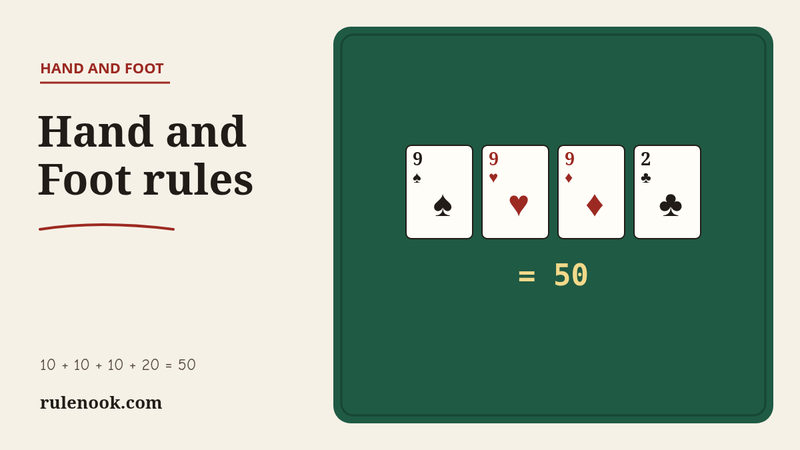
Example: deal 1, minimum 50. Someone discards a 9. You hold 9, 9 and a 2. Meld 9 9 9 2 for 10 + 10 + 10 + 20 = 50, take the top 7 cards, and finish your turn with a discard.
Black 3s: discarding one blocks the next player from taking the pile. They can never be melded, and each one left at the end costs 5.
When do you pick up your foot?
As soon as your hand is empty. If you meld every card in your hand, pick up your foot right away and keep playing, ending the turn with a discard from it. If you discard your last hand card instead, you pick up your foot at the start of your next turn.
How do you go out?
All 3 conditions must hold.
- Your side has at least 2 clean piles, 2 dirty piles and 1 wild pile.
- Your partner has picked up their foot and played at least part of a turn from it.
- You ask, "Partner, may I go out?" and your partner says yes.
Then meld all your remaining cards, or all but 1 and discard the last. Bicycle's rules always require that final discard. If you can't go out, you must keep at least 1 card in hand after your discard.
The deal also ends if someone needs to draw and the stock can't supply the cards. Then nobody gets the going-out bonus.
How do you score Hand and Foot?
Each side adds its bonuses and the card values of everything it melded, then subtracts the cards left in hands and in any foot that wasn't picked up.
| Bonus | Points |
|---|---|
| Each clean pile | 500 |
| Each dirty pile | 300 |
| Each wild pile | 1,500 |
| Going out | 100 |
| Each red 3 on the table | 100 |
Worked example: Side A goes out with exactly 2 clean, 2 dirty and 1 wild pile, plus 2 red 3s. Bonuses alone: 1,000 + 600 + 1,500 + 100 + 200 = 3,400, before card values.
Side B has 1 clean pile of kings (500 + 70), 1 dirty pile of five 9s and two 2s (300 + 50 + 40), 3 aces (60) and 1 red 3 on the table (100). One partner holds Q, 7 and a joker (65). The other never reached their foot, which holds a red 3 (−100) and 95 points of cards. Side B: 500 + 70 + 300 + 90 + 60 + 100 − 65 − 195 = 860.
After 4 deals, the higher total wins.
Common Rules Questions
How many books do you need to go out in Hand and Foot?
In the Pagat partnership rules, 5: 2 clean, 2 dirty and 1 wild pile, each exactly 7 cards. That's the strictest common version. Brian Brouillette's partner rules on Pagat need 2 clean and 2 dirty in deals 1 to 3. The Saskatchewan variation asks for 1 clean, 1 dirty and 1 wild, and Bicycle's rules just 1 clean and 1 dirty. Write your table's number on the score sheet before deal 1.
What happens to red 3s left in your foot?
They count against you. A red 3 is worth 100 once it's on the table, and you lay each one down as soon as you find it in your hand, your foot or a draw. If the other side goes out before you pick up your foot, every card in it counts against your side. Each red 3 there costs 100.
Is Hand and Foot the same as canasta?
Related, not the same. Both use wild 2s and jokers, red and black 3s and 7-card piles. Hand and Foot adds the foot, draws 2 cards a turn, takes only the top 7 discards, caps piles at 7, and scores a wild pile. Classic canasta uses 2 decks, 11 cards and a single hand. Our canasta page has those rules.
What to read next
Sources: John McLeod, Hand and Foot on pagat.com: Bill Whitnack's 4-player partnership rules (decks, deal, values, piles, wild limits, first-meld minimums, the turn, the foot, red and black 3s, going out, scoring) and the Saskatchewan variation; Bicycle, Hand and Foot (11-card hand and foot, 1 clean and 1 dirty book to go out, final discard required). All read 2026-10-10. Worked examples are our arithmetic, rechecked by script. Last updated 2026-10-10.
Sources
- John McLeod, Hand and Foot, pagat.com: partnership rules contributed by Bill Whitnack, plus Saskatchewan and Steve Simpson variants (read 2026-10-10)