Liverpool Rummy Rules: The 7 Contracts, Buying, Going Down and Scoring
Liverpool rummy is played over 7 deals, and each deal has a contract: a fixed mix of sets and runs you must lay down before you can play anything else. Sets are 3 of a rank; runs are 4 or more in one suit. Players who don't go out score penalty points for the cards left in hand, and the lowest total after deal 7 wins.
Liverpool is a member of the contract rummy family, along with Contract Rummy, May I? and Shanghai. The families share most rules. Where Liverpool tables commonly differ, we label it.
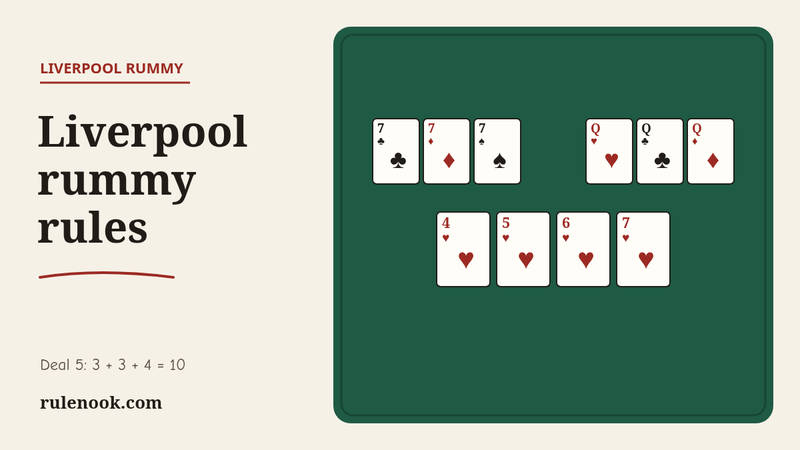
What are the 7 contracts?
| Deal | Contract | Cards needed |
|---|---|---|
| 1 | 2 sets of 3 | 6 |
| 2 | 1 set of 3 + 1 run of 4 | 7 |
| 3 | 2 runs of 4 | 8 |
| 4 | 3 sets of 3 | 9 |
| 5 | 2 sets of 3 + 1 run of 4 | 10 |
| 6 | 1 set of 3 + 2 runs of 4 | 11 |
| 7 | 3 runs of 4, all cards, no discard | 12 or more |
Each contract needs 1 more card than the last. That's why the deal grows: most Liverpool tables deal 10 cards for deals 1 to 4 and 12 for deals 5 to 7. Pagat's Contract Rummy deals 10 for the first 3 and 12 for the last 4. Either works if everyone knows.
What cards do you need?
Two standard 52-card decks shuffled together, plus jokers. Pagat's rule is 1 joker fewer than the number of players, so 4 players use 107 cards. Many groups simply use both decks' jokers. Larger groups often add a third deck, which is a house choice.
How does a turn work?
The player on the dealer's left starts. Play goes clockwise.
- Draw: take the top card of the stock or the top discard.
- Go down (meld your contract): once per deal, and only the exact contract.
- Lay off: on later turns only, add cards to any meld on the table.
- Discard: 1 card face up.
Going down: you must lay down exactly what the contract asks for, at one time. Under Pagat's rules, if you hold a run of 6 and the contract asks for 4, meld 4 now. The other 2 wait.
Same-suit runs: in deals 3, 6 and 7, two runs in the same suit can't continue each other. 3-4-5-6 and 7-8-9-10 of hearts don't count as 2 runs. They need a gap or an overlap.
Aces: high or low but not both. A-2-3-4 and J-Q-K-A are runs; Q-K-A-2 is not.
Jokers: wild in sets and runs. If a joker sits in a run and you hold the card it stands for, you may swap it in on your turn once you've gone down. Then play that joker right away.
How does buying work?
When the player whose turn it is draws from the stock instead of taking the top discard, any other player may buy that discard. The buyer takes it plus 1 penalty card from the stock, and doesn't discard. Then play goes on from where it stopped.
If 2 players want to buy, the one who would play sooner gets it. The player whose turn it is always has first claim, and pays no penalty for taking it normally.
Limits vary. Pagat's Contract Rummy allows any number of buys, though not 2 in a row by the same player. Many Liverpool tables cap it at 3 buys per player per deal. Pick a limit before deal 1.
How do you go out, and what is deal 7 like?
In deals 1 to 6 you go out by discarding your last card, after you've gone down and laid off everything else. In deal 7 there's no discard at all. You must lay down every card at once in 3 runs, so at least one run will be longer than 4. A player who has bought cards in deal 7 holds more than 13 after drawing, which makes it harder.
How do you score Liverpool?
When someone goes out, everyone else adds up the cards left in hand.
| Card | Penalty points |
|---|---|
| 2 to 10 | Face value |
| J, Q, K | 10 |
| Ace | 15 |
| Joker | 15 (many tables use 25 or 50) |
Worked example: C goes out in deal 2. B still holds K, 7, A and a joker: 10 + 7 + 15 + 15 = 47. D holds a pair of 3s: 6. C scores 0. After 7 deals, the lowest total wins.
Liverpool cut bonus: in one reported Liverpool rule, the player to the dealer's right cuts the deck. Cutting exactly the number of cards needed for the deal, plus 1 face-up card, takes 50 points off that player's score.
Common Rules Questions
How many times can you buy in Liverpool rummy?
There's no single rule. Pagat's Contract Rummy sets no limit, except that a player can't buy 2 discards in a row. Many Liverpool groups cap buys at 3 per player per deal, and track them with coins or chips. Each buy costs an extra stock card, so a player who buys 3 times holds 6 more cards than the deal gave them. Agree on the limit first.
Can you lay down more cards than the contract?
Under Pagat's Contract Rummy rules, no. You meld exactly the contract, 3 cards per set and 4 per run, and lay off extras from your next turn on. The May I? variant relaxes this, letting the first meld include longer runs and bigger sets. Many Liverpool tables also allow it. Since it speeds up going out, settle it before deal 1.
Can you lay off before you've gone down?
No. You can't add cards to any meld, yours or anyone else's, until you've laid down your own contract for that deal. Under Pagat's rules you also can't lay off on the same turn you go down; you wait for your next turn. That gap matters, because another player may go out first and catch your extras in hand.
What to read next
Sources: John McLeod, Contract Rummy family on pagat.com (contracts, decks and jokers, going down, laying off, buying, same-suit runs, deal 7, penalty values and Paul Welty's Liverpool cut rule); Wikipedia, "Liverpool rummy" (10 cards for deals 1 to 4, 12 for 5 to 7). Both read 2026-10-10. The worked example is our arithmetic, rechecked by script. Last updated 2026-10-10.
Sources
- John McLeod, Contract Rummy family incl. Liverpool Rummy, pagat.com (read 2026-10-10; snapshot verify/sources/pagat_ctrummy.html)
- Wikipedia, Liverpool rummy (deal sizes by round, read 2026-10-10)