3- and 4-Player Cribbage: Deal, Crib, Pegging Order and Partners
Cribbage is played by 2, 3 or 4 people. With 3, deal 5 cards each and 1 card straight to the crib; each player then adds 1 card to the crib. With 4, play as 2 partnerships sitting opposite, deal 5 cards each, and each player adds 1 card to the crib. Either way everyone keeps 4 cards and the crib has 4.
Everything else, from fifteens to his nobs, scores exactly as in the 2-player game, so if you're new to cribbage itself, start with how to play cribbage.
How does the deal change with more players?
| Players | Cards dealt each | Extra card to crib | Each player discards | Hand kept | Crib | Cards used before the starter |
|---|---|---|---|---|---|---|
| 2 | 6 | 0 | 2 | 4 | 4 | 12 |
| 3 | 5 | 1 from the deck | 1 | 4 | 4 | 16 |
| 4 (partners) | 5 | 0 | 1 | 4 | 4 | 20 |
The 4-card hand and 4-card crib never change, so the scoring chart works for every player count. Pegging is what changes, because with more players at the table, more cards go into each 31-count and runs get longer.
How do you play 3-player cribbage?
- Deal: 5 cards to each player, one at a time, and 1 card face down to the crib.
- Discard: each player puts 1 card in the crib. Everyone holds 4; the crib holds 4.
- Cut: the player to the dealer's left cuts for the starter.
- Pegging: the player to the dealer's left leads. Play goes clockwise.
- Show: count hands starting at the dealer's left and ending with the dealer, then the dealer counts the crib.
Each player scores alone. You need a board with 3 tracks. The 2 players who are behind sometimes gang up on the leader, playing to block runs and fifteens that would carry the leader home. That's legal. It's table politics.
How does pegging work with 3 or more players?
Nothing new scores. Same counts, same points: 2 for fifteen, 2 for a pair, 6 for 3 of a kind, a point per card for runs, 1 for the go and 2 for 31. Only the go changes.
When a player can't play without passing 31, they say "go" and drop out of that count. The next player keeps playing if they can. Play goes around until nobody can play. The last player to lay a card scores 1, or 2 if the count hits exactly 31. The count then starts again at 0, and the new count is led by the player sitting to the left of whoever played the last card.
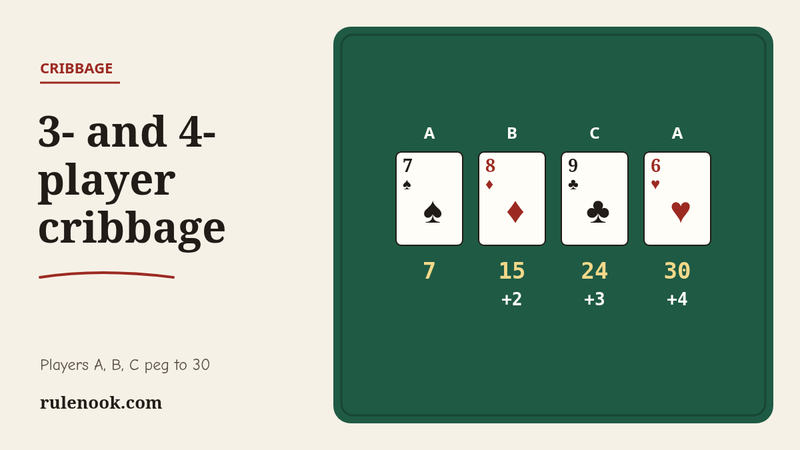
Worked example, 3 players: A, B and C, with A to the left of the dealer.
| Play | Card | Count | Points |
|---|---|---|---|
| A | 7 | 7 | 0 |
| B | 8 | 15 | 2 for fifteen |
| C | 9 | 24 | 3 for the run 7-8-9 |
| A | 6 | 30 | 4 for the run 6-7-8-9 |
| B, C, A | go, go, go | 30 | A scores 1 for last card |
A pegs 4 + 1 = 5 on this count. B leads the next count, starting from 0.
How do you play 4-player cribbage?
Partners sit opposite each other and score together on one track, and many tables let just one player per team handle the pegs for both.
- Cut for deal: under ACC doubles rules, all 4 players cut from a fanned deck and low card deals first. The deal then rotates to the left.
- Before the deal: the player to the dealer's right cuts the pack.
- Deal: 5 cards each, 20 in all. Each player puts 1 card in the dealer's crib.
- Starter: the player to the dealer's left cuts for it. A jack gives the dealer's team 2 for his heels. They must claim it before the dealer's partner plays a first card.
- Pegging and show: start left of the dealer, go clockwise, and the crib is counted last.
Worked example, 4 players: seats 1 and 3 are partners against the dealer and the dealer's partner in seat 2. Seat 1 plays a 4. Seat 2 plays a 4 for a pair (2 points). Seat 3 plays a 4 for 3 of a kind (6 points).
The dealer plays a 5 for a count of 17 and scores nothing. Seat 3 pegs those 6 points for the team, even though it was their partner who started the run of 4s.
Table talk: the ACC lets partners point out points ("that's a run of four") and the score, but not ask for cards or say what's in hand. "Play your 5" isn't allowed.
Canadian doubles works differently. One player on each team, the hand-setter, gets 10 cards and splits them into 2 hands of 4, discarding 2 to the crib. It's covered in the ACC rule book's Appendix B.
Common Rules Questions
In 3- or 4-player cribbage, who plays next after a "go"?
The player to the left of whoever said go, if they can play. A go only takes you out of the current count. Play keeps moving around the table, skipping anyone who has passed, until nobody can add a card without going over 31. The last player to lay a card scores 1, or 2 for exactly 31, and the next count is led by the player sitting to that person's left.
How many people can play cribbage?
Two to four. The 2-player game is the standard one and the one the American Cribbage Congress rule book is written around. Four players play in 2 partnerships, which the ACC covers under doubles. Three players each play alone, with a special deal. Five or more is unusual. Larger groups usually split into 2 tables.
Does the crib still go to the dealer with 3 or 4 players?
Always. The dealer owns the crib in every version, and the deal passes to the left after each hand, so everyone gets the crib in turn. In 4-player cribbage the crib scores for the dealer's team, so the dealer's partner discards to help their own side while the opponents discard to hurt it. With 3 players, 1 crib card comes straight from the deck. So the crib still has 4.
What to read next
Sources: American Cribbage Congress, Official Rules (2025), Appendix B. It covers the 20-card deal, 1-card discards, both cuts, his heels, table talk and Canadian doubles. Pagat, Six Card Cribbage (three-handed and four-handed play, the go with more than 2 players, order of the show). Pegging examples rechecked by script. Last updated 2026-10-10.
Sources
- American Cribbage Congress, Official Rules (2025), Appendix B: Doubles (evidence/acc_rulebook_2025.pdf)
- John McLeod, Six Card Cribbage, pagat.com: three-handed and four-handed play (read 2026-10-10; snapshot verify/sources/pagat_cribbage.html)