Cribbage Scoring Chart: How to Count a Hand, With the Odds of Every Score
A cribbage hand is worth 0 to 29 points: you score 2 for every set of cards that adds to 15, 2 for every pair, 1 per card in a run, 4 or 5 for a flush, and 1 for nobs.
We counted every possible hand. Across all 12,994,800 combinations of 4 cards plus a starter, the average hand is worth 4.77 points, and the single most common score is 4 (just ahead of 2).
What does each combination score?
These are the hand and crib values from the American Cribbage Congress rule book (2025 edition, Rule 1.7), which is what tournament directors use when your table can't agree. When you add to 15, face cards count 10 and an ace counts 1.
| Combination | Points | Official rule note |
|---|---|---|
| Fifteen (any cards that add to 15) | 2 each | Every different set of cards counts separately |
| Pair | 2 | Two cards of the same rank |
| Three of a kind | 6 | Three pairs, so 3 × 2 |
| Four of a kind | 12 | Six pairs, so 6 × 2 |
| Run of 3, 4 or 5 | 1 per card | A-2-3 is a run; Q-K-A is not |
| Four-card flush | 4 | Hand only, never the crib |
| Five-card flush | 5 | Hand or crib; the starter must match |
| Nobs | 1 | Jack in hand or crib of the starter's suit |
One jack rule lives outside this table. His heels: if the dealer turns a jack as the starter, the dealer pegs 2 at once. You score that 2 at the cut, not in the show, so none of the odds further down include it.
In what order should you count?
Count the same way every time. Your opponent can follow along, and you will miss fewer points (in a game played with muggins, the points you miss go to the other player).
- Fifteens. Say them out loud: "fifteen 2, fifteen 4." Start with your highest card and work down, so that no set of cards gets counted twice.
- Pairs. Two of a rank is 2. Three of a rank is 6, because three cards hold 3 different pairs.
- Runs. Find the longest run first. If you hold a duplicate of any card in the run, you have two runs, not one.
- Flush. Four cards of one suit in your hand score 4; if the starter matches, you score 5.
- Nobs. Check last for a jack in the starter's suit.
To check a count, enter the 5 cards in our cribbage hand calculator. For the full deal, crib and pegging, see how to play cribbage.
Three hands, counted out
Each total below was rerun through our scoring script. The order you hold the cards in doesn't matter, and suits only come into it for the flush and for nobs.
Hand: 4-6-6-7, starter 5. Fifteens: 4+5+6 works twice (once with each 6), so 4 points. Pair of 6s: 2 points. Runs: 4-5-6-7 also works once with each 6, which gives you two 4-card runs and 8 points. Total: 14.
Hand: 2-3-4-K, starter Q. Fifteens: 2+3+K and 2+3+Q, so 4 points. Run of 2-3-4: 3 points. There are no pairs, and the K-Q doesn't extend the run because J is missing. Total: 7.
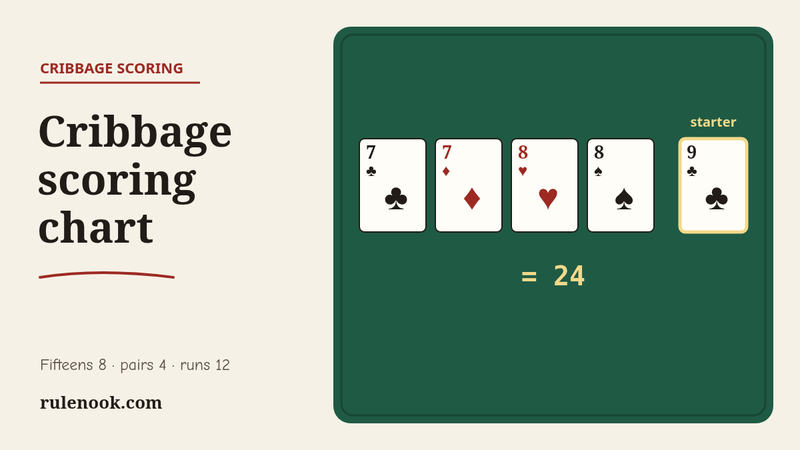
Hand: 7-7-8-8, starter 9. Fifteens: each 7 with each 8, so 4 fifteens and 8 points. Two pairs: 4 points. Runs: 7-8-9 can be built 4 ways, which is 12 points. Total: 24.
That third hand is a "double double run," and it's the one people undercount. If you only see 2 runs you'll stop at 16, but you have two 7s and two 8s, so there are 4 different ways to pick a 7 and an 8 for the run.
The 28 and the 29
Four 5s with any 10-point starter scores 28. The five cards make 8 different fifteens (16 points), and the four 5s hold 6 pairs (12 points).
The 29 is the same idea with one swap. You hold J-5-5-5, and the starter is the fourth 5 in the same suit as your jack. You get 16 for fifteens, 12 for pairs and 1 for nobs, which is the highest count the rules allow.
Which flush counts, hand or crib?
This is the rule tables argue about most. The official answer is short.
| Cards | In your hand | In the crib |
|---|---|---|
| 4 cards same suit, starter different | 4 | 0 |
| 4 cards same suit, starter matches | 5 | 5 |
| 3 cards same suit plus a matching starter | 0 | 0 |
A common house rule lets a 4-card crib flush score 4. That rule is not in the ACC book, so if your table plays it, say so before the first deal rather than in the middle of a count.
How likely is each score?
We scored every hand of 4 cards with every possible starter from the remaining 48 cards: 270,725 hands × 48 starters, or 12,994,800 combinations. These are hand counts, so the crib's stricter flush rule isn't applied.
| Score | Combinations | Share | Share scoring at least this |
|---|---|---|---|
| 0 | 1,009,008 | 7.765% | 100% |
| 1 | 99,792 | 0.768% | 92.24% |
| 2 | 2,813,796 | 21.653% | 91.47% |
| 3 | 505,008 | 3.886% | 69.81% |
| 4 | 2,855,676 | 21.976% | 65.93% |
| 5 | 697,508 | 5.368% | 43.95% |
| 6 | 1,800,268 | 13.854% | 38.58% |
| 7 | 751,324 | 5.782% | 24.73% |
| 8 | 1,137,236 | 8.751% | 18.95% |
| 9 | 361,224 | 2.78% | 10.2% |
| 10 | 388,740 | 2.992% | 7.42% |
| 11 | 51,680 | 0.398% | 4.43% |
| 12 | 317,340 | 2.442% | 4.03% |
| 13 | 19,656 | 0.151% | 1.59% |
| 14 | 90,100 | 0.693% | 1.44% |
| 15 | 9,168 | 0.071% | 0.74% |
| 16 | 58,248 | 0.448% | 0.67% |
| 17 | 11,196 | 0.086% | 0.22% |
| 18 | 2,708 | 0.021% | 0.14% |
| 19 | 0 | 0% | 0.12% |
| 20 | 8,068 | 0.062% | 0.12% |
| 21 | 2,496 | 0.019% | 0.05% |
| 22 | 444 | 0.003% | 0.04% |
| 23 | 356 | 0.003% | 0.03% |
| 24 | 3,680 | 0.028% | 0.03% |
| 25–27 | 0 | 0% | <0.01% |
| 28 | 76 | 0.001% | <0.01% |
| 29 | 4 | <0.001% | <0.01% |
What the table says:
- About 1 hand in 13 scores nothing: 7.76% of all combinations.
- Half of all hands score 4 or less. The median is 4.
- Only 7.42% of hands reach 10 points, and 0.67% reach 16.
- No hand can score 19, 25, 26 or 27. That's why players say "nineteen" for a hand worth zero.
- The 29 shows up 4 times in 12,994,800, once per suit of jack. That works out to 1 in 3,248,700 per hand and starter.
You'll see other odds for a 29 quoted elsewhere. Those use different setups (for example, counting the 6 cards you're dealt before you discard), so they won't match this figure, and they don't need to.
Points you peg during play
The show is only half the game. You peg these as cards hit the table, and the values come from the same rule book.
| During play | Points |
|---|---|
| Count reaches exactly 15 | 2 |
| Count reaches exactly 31 | 2 |
| Last card, count under 31 | 1 |
| Pair / three / four of a kind | 2 / 6 / 12 |
| Run of 3 or more | 1 per card |
| Dealer turns a jack as starter | 2 |
A game goes to 121 on a standard board, which has four streets of 30 holes and then the game hole. If you play with 2 people you need two tracks; if a third player joins, you need a three-track board.
Common Rules Questions
Which cards should you keep and which should you throw to the crib?
Keep the 4 cards that score the most with the most possible starters, then think about the crib. When it's your crib, throwing a 5, a pair, or two cards that add to 15 helps you. When it's your opponent's crib, avoid giving them 5s, pairs, and cards next to each other in rank, such as 7-8. Our hand calculator can score each choice.
Does the starter card count for every hand and the crib?
Yes. The starter is the fifth card for the pone's hand, the dealer's hand and the crib alike. It stays on top of the deck and nobody takes it into their hand. It can be used in any combination, so one starter can complete a fifteen, a pair and a run all at once in the same count.
Can the same card be used in more than one combination?
Yes, and that's where most points come from. A card can be part of several fifteens, a pair and a run in the same count, as long as each combination is a different set of cards. In 5-5-5-J with a 5 starter, each 5 appears in 3 separate pairs and in 4 different fifteens.
What to read next
- Cribbage hand calculator: enter 5 cards and see the count.
- How to play cribbage: the deal, the crib and pegging, step by step.
- Three- and four-player cribbage: what changes in the deal and the crib.
- How to choose a cribbage board: 2-track, 3-track and continuous boards compared.
- Playing cards for card games: bridge vs poker size, and how many decks each game needs.
- All card game rules: rummy, spades, euchre and more.
Sources: American Cribbage Congress, Rules of Cribbage (2025), Rule 1.7 scoring chart and Rule 6.3. Odds: our full enumeration script, published on the methodology page. Last updated 2026-10-10.
Sources
- American Cribbage Congress, Rules of Cribbage (2025), Rule 1.7 and Rule 6.3 (evidence/acc_rulebook_2025.pdf)
- cribbage_calc.py full enumeration (cribbage_calc_output.json)