How to Play Spades: Bidding, Tricks, Nil and Bags
Spades is a trick-taking game for 4 players in 2 partnerships. Each player gets 13 cards and bids how many tricks they'll win; spades always beat the other suits. Your team scores 10 points per trick bid if it makes the bid and loses that much if it falls short, and the first team to 500 wins.
No organization owns the rules of spades. Bicycle publishes a version, and the partnership game with nil and bags that most clubs and apps use differs from it in a few places. We follow the partnership game and mark every rule that tables commonly change.
What do you need and how do you deal?
| Item | Count |
|---|---|
| Players | 4, partners sitting opposite each other |
| Deck | 1 standard deck of 52, no jokers |
| Cards per player | 13 (the whole deck) |
| Spades in the deck | 13, A high down to 2 |
| Paper and pen | 1, for bids and the running score |
Draw for the first deal. High card deals. The dealer gives out the whole deck one card at a time, face down, starting with the player on the left, and the deal passes clockwise after every hand. Playing with 2 or 3? The deal and scoring change; see spades for 2 or 3 players.
How does bidding work?
Starting at the dealer's left, each player says one number, the tricks they expect to win. There's one round of bidding and no passing. Partners add their bids together to make the team's contract.
| Bid | What it means |
|---|---|
| 1 to 13 | You'll take at least that many tricks, together with your partner's bid |
| Nil (0) | You personally will take no tricks at all; your partner's bid stands alone |
| Blind nil | Nil, bid before you look at your cards (house rule at many tables) |
A hand has 13 tricks, so the 4 bids usually add up to somewhere between 10 and 13. Low total? Expect overtricks. When the total is 14 or more, at least one team must fail, because there aren't enough tricks to go around.
How do you play the tricks?
- The player on the dealer's left leads the first trick.
- Everyone must follow the suit that was led if they can.
- If you can't follow suit, play any card, including a spade.
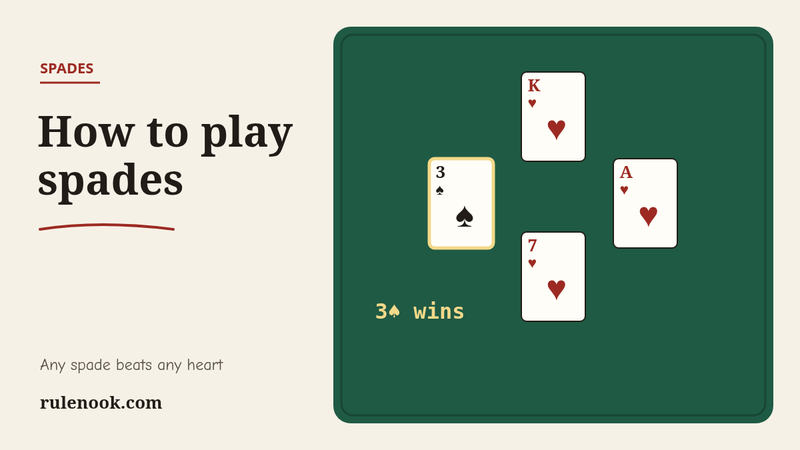
- The highest spade wins the trick. With no spade in it, the highest card of the suit led wins.
- The winner of each trick leads the next one.
Breaking spades. You may not lead a spade until a spade has been played on another suit's lead (spades are then "broken"). The one exception: if your hand holds nothing but spades, you may lead one.
Official rule vs house rule. Bicycle's rules start with the player left of the dealer. A widespread house rule says whoever holds the 2♣ leads it to the first trick. Some of those tables also bar spades from the first trick entirely.
How is a hand scored?
This is the partnership scoring most tables use. Full worked score sheets, including nil and the bag penalty, are on our spades scoring page.
| Result | Points |
|---|---|
| Team makes its contract | 10 x contract |
| Each trick over the contract (a "bag") | +1 |
| Every 10 bags a team collects | −100 |
| Team takes fewer tricks than its contract | −10 x contract |
| Nil made | +100 |
| Nil failed | −100 |
Worked example. North bids 3 and South bids 2, so North-South have a contract of 5. East bids 4 and West bids 2 for a contract of 6. North-South take 7 tricks and East-West take 6.
- North-South: 5 x 10 = 50, plus 2 bags = 52. They note 2 bags toward the next penalty.
- East-West: exactly 6, so 6 x 10 = 60 and no bags.
Official rule vs house rule. Bicycle's published version scores each player separately, scores 0 for a missed bid instead of a minus, and treats the bag penalty as optional. If your group learned from that sheet, its scores will look different from the table above.
How does a game end?
The first team to reach 500 points wins. If both teams pass 500 on the same hand, the higher score wins. Bicycle suggests 200 for a short game. Many tables also end the game when a team falls to −200, which is a house rule.
Common Rules Questions
Can you lead a spade if you only have spades left?
Yes. The breaking rule only stops you from leading a spade while you still hold cards in other suits. Once spades are the only cards in your hand, you may lead one even if no spade has been played yet, and spades count as broken from then on. If you lead a spade while holding a heart, that's a misplay; most tables make you take it back.
What happens if a player fails to follow suit when they could have?
That's a renege. There's no published penalty everyone uses. Common house rule: the offending team gives up 3 tricks to the other team at the end of the hand, or the hand is replayed if the error is caught early. A renege only counts once the trick is turned over, so a player who catches their own mistake right away can usually fix it.
Can partners talk about their hands during bidding?
No. Just the number. Saying things like "I've got a weak hand" or pointing out spades is table talk, and most groups treat it as cheating. Partners may see each other's bids because they're spoken out loud and written on the score sheet. Looking back at earlier tricks follows the same rule as in euchre; see our euchre page.
What is the goal of spades in one sentence?
Bid accurately, then take exactly that many tricks with your partner. Taking too few costs 10 points per trick bid. Taking too many adds bags, and every 10 bags costs 100 points, so a team that overbids or underbids every hand loses to a team that hits its number.
What to read next
- Spades scoring with sample score sheets
- Spades for 2 or 3 players
- Playing cards for card games
- All card game rules
Sources: Bicycle, Spades: deal, bidding, leading and the breaking rule, individual scoring variant, 500 and 200 targets (read 2026-10-10). Partnership scoring with nil and bags as commonly played; there is no governing body. Last updated 2026-10-10.
Sources
- Bicycle, Spades rules, bicyclecards.com/how-to-play/spades (read 2026-10-10)
- Partnership scoring as used by most clubs and apps (no governing body; labeled where tables differ)