Spades for 2 or 3 Players: How the Deal and Scoring Change
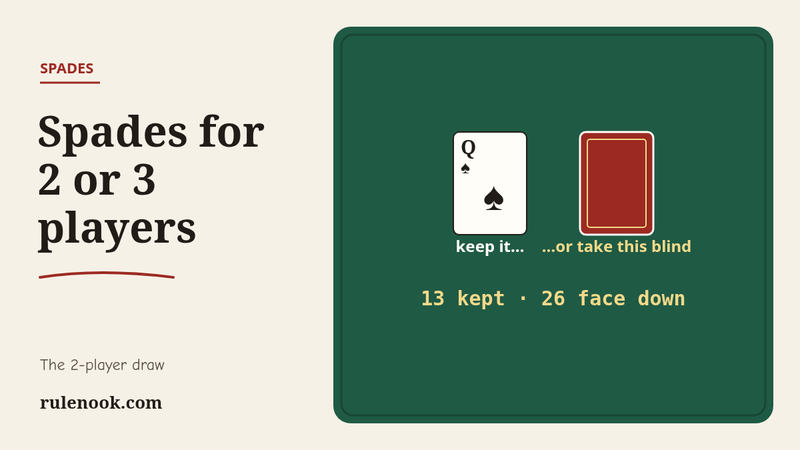
With 3 players, remove the 2♣ and deal 17 cards each; everyone plays and scores alone. With 2 players, you build your 13-card hands by drawing from the deck one card at a time, keeping one card and throwing away another, until 26 cards are discarded.
Everything else follows the 4-player game: spades are always trump, you must follow suit, and spades can't be led until broken. If you haven't played before, read how to play spades first. Spades has no governing body, so every short-handed rule here is a common convention, not an official one.
How do the numbers change with fewer players?
| Players | Cards removed | Cards per player | Tricks per hand | Teams | Usual target |
|---|---|---|---|---|---|
| 4 | 0 | 13 | 13 | 2 partnerships | 500 |
| 3 | 1 (the 2♣) | 17 | 17 | None, everyone alone | 300 or 500 |
| 2 | 26 discarded during the draw | 13 | 13 | None | 300 or 500 |
The deck always starts at 52 cards. In the 3-player game, 52 − 1 = 51 cards split evenly into 3 hands of 17, while in the 2-player game each player looks at up to 26 cards during the draw but keeps only 13 of them.
How do you play spades with 3 players?
- Take the 2♣ out of the deck. That leaves 51 cards.
- Deal all 51 one at a time, so each player gets 17.
- Starting left of the dealer, each player bids alone. Bids can run from nil to 17.
- The player left of the dealer leads. Follow suit if you can; spades win; spades can't be led until broken.
- Score each player separately with the usual table: 10 per trick bid, +1 per overtrick, −10 per trick bid if you miss.
With no partner, every trick you don't take goes to someone who is trying to beat you, which is why 3-player spades is sometimes called cutthroat spades.
Worked example, 3 players. Ann bids 5, Ben bids 6 and Cal bids 4. That's 15 of the 17 tricks. Ann takes 6, Ben takes 6, Cal takes 5, which adds up to 17.
- Ann: 5 x 10 + 1 bag = 51.
- Ben: 6 x 10 = 60, no bags.
- Cal: 4 x 10 + 1 bag = 41.
How do you play spades with 2 players?
No partner, no full deal. You draft your hand from the deck, one decision per draw, and the cards you throw away stay hidden from your opponent for the rest of the hand.
- Shuffle and place the deck face down between you. The non-dealer draws first.
- Look at the top card. If you want it, keep it, then take the next card and discard it face down without showing it.
- If you don't want the first card, discard it face down. You must keep the next card.
- Players alternate until the deck is gone. Each of you now holds 13 cards, and 26 are face down in the discard pile.
- Bid, with the non-dealer bidding first. Then play 13 tricks, with the non-dealer leading.
Every draw is a choice between the card you see and a card you can't see, and you make 13 of those choices before a single trick is played.
Worked example, 2 players. You bid 6 and your opponent bids 5. You take 7 tricks and your opponent takes 6, for 13 in all.
- You: 6 x 10 + 1 bag = 61.
- Opponent: 5 x 10 + 1 bag = 51.
Does the scoring change with fewer players?
Only in who gets the points. Each player keeps a personal score and a personal bag count, and the usual values from the 4-player game apply to each of them without any change. Full tables and a 5-hand worked sheet are on our spades scoring page.
| Result | Points |
|---|---|
| Bid made | 10 x bid |
| Each overtrick | +1, and 1 bag |
| Every 10 bags | −100 |
| Bid missed | −10 x bid |
| Nil made / failed (if your table allows it) | +100 / −100 |
Official rule vs house rule. Bicycle's individual rules score a missed bid as 0, not a minus, and make bags optional. Many 2- and 3-player tables use those gentler rules, since there's no partner to cover a bad hand. Decide before the first deal and write the choice on the score sheet.
Common Rules Questions
Which card do you remove in 3-player spades?
Most tables remove the 2♣, because it's the lowest card in a side suit and almost never wins a trick. Some remove the 2♦ instead, which plays the same. Don't remove a spade: that changes the trump count from 13 to 12 and makes spade bids harder to judge. Whatever you remove, keep it out of sight so nobody counts on it.
Can you bid nil with only 2 or 3 players?
Yes, if your table agrees. Nil is harder to make with no partner, since nobody at the table will play high to save you, and one stranded high card is enough to break it. Players who allow it usually keep the standard +100 and −100. A few 2-player tables drop nil entirely, because the blind draw already leaves each hand uneven. Agree on it before play, along with blind nil.
How long is a game with 2 or 3 players?
Shorter targets are common, because with 500 points and individual scores a 3-player game can easily run past 10 hands. Many tables play to 300, or use 200, which Bicycle suggests for a short game. A useful check: with an average of about 55 points per hand, 300 takes roughly 6 hands.
What to read next
- How to play spades
- Spades scoring with sample score sheets
- Card games for 2 players
- All card game rules
Sources: Bicycle, Spades: individual scoring, 500 and 200 targets (read 2026-10-10). The 2-player draw and 3-player 17-card deal are common conventions; spades has no governing body. Worked examples are our arithmetic. Last updated 2026-10-10.
Sources
- Bicycle, Spades rules (individual scoring), bicyclecards.com/how-to-play/spades (read 2026-10-10)
- 2- and 3-player conventions as commonly played (no governing body; labeled)