How to Keep Score in Spades: Bids, Bags, Nil and Sample Score Sheet
To score a hand of spades, multiply your team's bid by 10 if you took at least that many tricks, then add 1 point for each extra trick (a "bag"). Miss the bid and you lose 10 points per trick bid. Every 10 bags costs 100 points, and a nil scores 100 if it's made and loses 100 if it isn't.
These are partnership rules for 4 players, as most clubs and apps play them, and because there is no governing body for spades we flag every spot where tables commonly differ. If you need the rules of play first, start with how to play spades.
What is each result worth?
| Result | Points | Rule note |
|---|---|---|
| Contract made | 10 x bid | Team bid = sum of both partners' bids |
| Each overtrick | +1, and 1 bag | Bags carry over from hand to hand |
| 10 bags reached | −100 | Then subtract 10 from the bag count |
| Contract missed | −10 x bid | Overtricks don't exist if you missed |
| Nil made | +100 | Scored for the nil bidder's team, on top of the partner's result |
| Nil failed | −100 | Partner's contract is still scored separately |
| Blind nil made / failed | +200 / −200 | House rule; many tables require being 100 or more behind |
How do you keep score on paper?
Draw one column per team, each split in two: bid and tricks on the left, points and running total on the right. Add a small bag tally in the corner of each column. Write the bids down before the first card is played, because the score sheet is the only record anyone can check later.
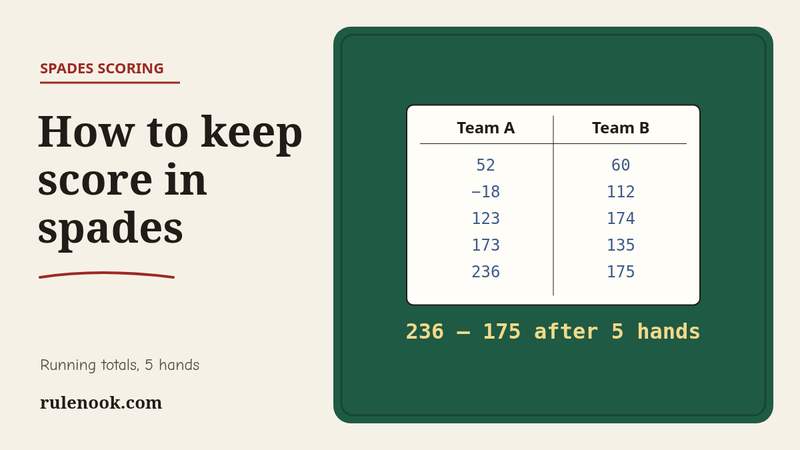
Sample score sheet: 5 hands, counted out
North-South are Team A; East-West are Team B. Each row's tricks add up to 13. Every number below was rerun through our scoring script.
| Hand | A bid | A tricks | A points | A total | A bags | B bid | B tricks | B points | B total | B bags |
|---|---|---|---|---|---|---|---|---|---|---|
| 1 | 5 | 7 | +52 | 52 | 2 | 6 | 6 | +60 | 60 | 0 |
| 2 | 7 | 6 | −70 | −18 | 2 | 5 | 7 | +52 | 112 | 2 |
| 3 | Nil + 4 | 0 + 5 | +141 | 123 | 3 | 6 | 8 | +62 | 174 | 4 |
| 4 | 5 | 5 | +50 | 173 | 3 | Nil + 6 | 1 + 7 | −39 | 135 | 6 |
| 5 | 6 | 9 | +63 | 236 | 6 | 4 | 4 | +40 | 175 | 6 |
Hand 1. Team A bid 5 and took 7: 50 for the bid plus 2 bags makes 52. Team B bid 6 and took exactly 6, so 60 and no bags.
Hand 2. Team A bid 7 but took only 6. They lose 7 x 10 = 70 and drop to −18. Team B bid 5 and took 7, scoring 52 and reaching 2 bags.
Hand 3, a nil made. North bid nil and took 0 tricks: +100. South bid 4 and took 5: 40 + 1 bag = 41. Team A scores 100 + 41 = 141 in one hand and climbs to 123.
Hand 4, a nil failed. East bid nil but won 1 trick: −100. West bid 6 and took 7: 60 + 1 = 61. Team B nets 61 − 100 = −39. East's trick doesn't help West's bid in our sheet, but it does count as a bag, so Team B adds 2 bags, not 1.
Hand 5. Team A bid 6 and took 9. That's 63, and their bag count reaches 6. Team B made 4 exactly for 40. After 5 hands it's 236 to 175, and both teams sit 4 bags away from a penalty.
How does the bag penalty work?
Keep a running bag count for each team. At 10, take 100 points off. Then subtract 10 bags and carry any extra bags into the next hand, so a team at 12 bags pays once and starts again at 2.
Worked example. Your team carries 8 bags. You bid 4 and take 7. The hand is worth 40 + 3 = 43, but the 3 bags push your count to 11. Subtract 100 and you net −57 for the hand. Your bag count restarts at 1.
Small leaks add up. One spare trick per hand looks harmless, yet over 10 hands it costs 100 points, which is as much as a team loses for missing a bid of 10.
How do you score spades with 2 or 3 players?
Each player scores alone, using the same table: 10 per trick bid, 1 per bag, −10 per trick bid if you miss, and −100 per 10 bags. Nothing gets added to a partner's bid. The deal and the target score change too; see spades for 2 or 3 players.
Official rule vs house rule. Bicycle's individual rules score a missed bid as 0, not as a minus, and make the bag penalty optional. Pick one system.
How does the game end?
First to 500 wins. If both teams pass 500 on the same hand, the higher total wins, and a tie at the top is usually broken by playing one more hand. A common house rule ends the game early when a team drops to −200 or below.
Common Rules Questions
What exactly is a bag?
An overtrick. Each bag is worth 1 point at once, but bags pile up across hands, and every 10 bags costs your team 100 points. The penalty exists to stop teams from bidding low on purpose and collecting easy overtricks, and some tables call bags "sandbags" and the penalty "bagging out."
Should you bid high or low in spades?
Bid what you expect to take. Missing by a single trick costs you 10 points per trick bid, so a missed bid of 5 swings the hand by 50 or more. Bidding one too low only costs a bag. That makes a slightly low bid safer in a single hand. The catch is the 10-bag penalty, so if your team already holds 7 or 8 bags, bid closer to your real count.
Do tricks taken by a failed nil count toward the partner's bid?
Ask your table. In our worked examples they don't: the nil bidder's tricks never help the partner's contract, and they count as bags. Common house rule: the failed nil's tricks do count toward the partner's bid. The difference matters when the partner is 1 trick short, so settle it before you deal.
Is a blind nil an official bid?
No bid in spades is official in the strict sense, since no organization owns the rules. Blind nil is a common house rule: you bid nil before looking at your cards, for +200 if made and −200 if not. Many tables only allow it when your team trails by 100 or more. Some also let the blind nil bidder swap 2 cards with their partner.
What to read next
Sources: Bicycle, Spades: individual scoring, optional bag penalty, 500 target (read 2026-10-10). Partnership scoring with nil and bags as commonly played; no governing body. All sample totals recomputed by our scoring script, see methodology. Last updated 2026-10-10.
Sources
- Bicycle, Spades rules, bicyclecards.com/how-to-play/spades (read 2026-10-10)
- Partnership scoring as commonly played (no governing body)