The Charleston in American Mahjong: Every Pass, Blind Passes and the Courtesy Pass
The Charleston is the tile swap at the start of every 4-player American mahjong game. Everyone passes 3 tiles right, then across, then left; that first round is required. A second round (left, across, right) is optional, and a courtesy pass of 0 to 3 tiles across ends it. Jokers are never passed.
Up to 7 passes in all. Because they happen before the first discard, nothing you pass can be called, and no points change hands until the play itself begins.
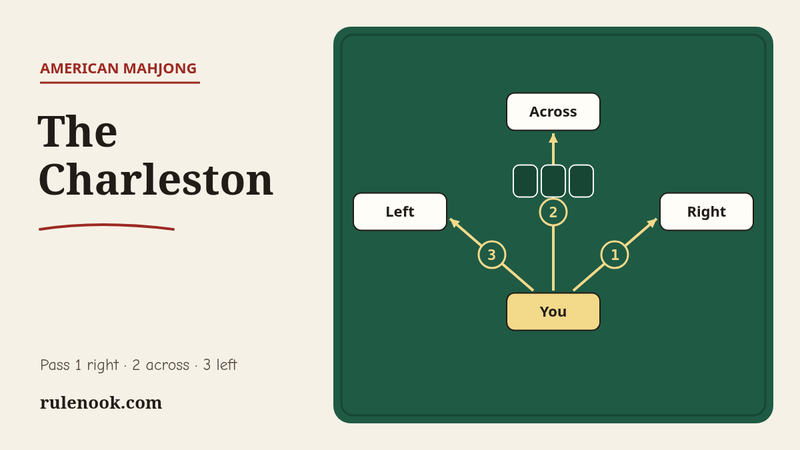
What is the order of the passes?
| # | Pass | Direction | Tiles | Required? | Blind pass allowed? |
|---|---|---|---|---|---|
| 1 | First right | To your right | 3 | Yes | No |
| 2 | First across | To the player opposite | 3 | Yes | No |
| 3 | First left | To your left | 3 | Yes | Yes |
| 4 | Second left | To your left | 3 | Only if nobody stops it | No |
| 5 | Second across | To the player opposite | 3 | Only if nobody stops it | No |
| 6 | Second right | To your right | 3 | Only if nobody stops it | Yes |
| 7 | Courtesy | To the player opposite | 0 to 3 | Optional | No |
A handy memory aid for the first round is "right, over, left." The second round runs the same steps in reverse. Notice that passes 3 and 4 both go left, so you send tiles to the same player twice in a row.
How do you pass tiles?
Place 3 tiles face down on the table in front of the player you're passing to. Then pick up the 3 tiles that arrive from the other side. Everyone passes at once, so wait until all 4 players have put their tiles down before you pick up.
Official rule: pass exactly 3 tiles, face down, never a joker. A joker you hold stays in your rack through the whole Charleston.
Common table habit: say the direction out loud ("passing right") as you push the tiles, which cuts down on tiles sent the wrong way. It isn't a rule, just good manners.
What is a blind pass?
On the last pass of each round, pass 3 (first left) and pass 6 (second right), you may "steal" or blind pass. You pass on 1, 2 or all 3 of the tiles you've just been handed, without looking at them, and make up the rest of the 3 from your own rack.
Why bother? Late in a round your hand has taken shape. Breaking up a pair you need to fill 3 slots costs more than passing along tiles you have never seen, so a blind pass protects the hand.
Example: you hold no throwaways after the first across. Tiles from the right arrive face down. You pick up 1 to look at, keep it, and push the other 2 on to the left unseen, along with 1 tile from your rack. That's a legal 3-tile pass.
How does the second Charleston get stopped?
After the first left, any one player may stop the Charleston. One "no" is enough; no reason is needed and there's no vote. If nobody stops it, all 4 players do the full second round. You can't stop it partway, after the second left has started.
Courtesy pass next. Always.
How does the courtesy pass work?
You and the player across agree on how many tiles to swap: 0, 1, 2 or 3. If one of you wants 3 and the other wants 1, the lower number wins, so you each pass 1. Either player can choose 0, which cancels it for your pair only. The other 2 players make their own deal.
Worked example: one hand through 7 passes
The hand below is a made-up hand, not a line from any NMJL card. The point is the decision at each pass.
| Pass | You send | Why |
|---|---|---|
| 1. Right | 1 Dot, 9 Crak, North | Lone tiles in suits and winds you're not collecting |
| 2. Across | 4 Bam, 6 Bam, West | You've chosen to build in Craks and Dots |
| 3. Left (blind) | 2 tiles unseen, plus 1 Flower | Hand is set; you protect your pairs |
| 4. Second left | 7 Dot, East, Red Dragon | Nobody stopped the round, so you must pass 3 |
| 5. Second across | 2 Bam, 8 Bam, Green Dragon | Still clearing Bams |
| 6. Second right (blind) | 3 tiles unseen | You hold nothing you want to give up |
| 7. Courtesy | 1 tile (your partner offered 1) | Lower number of the 2 offers |
Count check: 6 required passes of 3 tiles is 18 tiles out and 18 in. Your rack never drops below 13 tiles, or 14 if you're East.
What do 3 and 2 players do?
They skip it. Under the League's short-handed rules there is no Charleston with fewer than 4 players, not even the courtesy pass, and East simply opens with a discard. Some groups add a ghost player to keep the passes; that's a house rule, covered on our 2- and 3-player page.
Common Rules Questions
Can you declare Mah Jongg during the Charleston?
Only East can, because only East holds 14 tiles. If East is dealt a complete hand, East declares before any passing: the Charleston is waived and it's paid as self-drawn, double from all 3 players. If a Charleston round leaves East with a winning hand, East may declare once that round is over. The other 3 players hold 13 tiles and must wait for play.
Why is the tile pass called the Charleston?
The usual explanation is the 1920s dance of the same name, popular when mahjong reached the United States. The tiles move right, across and left, much as dancers stepped side to side. Nice story. We haven't found a documented source for it, so treat it as table lore.
Can you pass a joker in the Charleston if your partner agrees?
No. The rule against passing jokers has no exception for agreement between players, and it covers every pass, including blind passes and the courtesy pass. A joker that reaches you during the Charleston stays in your rack. If a joker turns up in a blind pass you're about to push on, that's a mistake to fix before the tiles leave your hand.
What to read next
- American mahjong rules, start to finish
- Jokers in American mahjong
- How to set up mahjong
- All mahjong rules
Sources: National Mah Jongg League, Mah Jongg Made Easy: Charleston order, stopping the second Charleston, blind passes, courtesy pass and the Heavenly Hand, as quoted in the League's published answers (Mahj Life) and Tom Sloper's columns; not checked against the book itself. The worked hand is invented and is not from any NMJL card. Last updated 2026-10-10.
Sources
- National Mah Jongg League, Mah Jongg Made Easy (Charleston section, via NMJL answers quoted by Mahj Life, read 2026-10-10)
- Tom Sloper, Sloper On Mah-Jongg #666 (Heavenly Hand and East during the Charleston)