American Mahjong Rules: Setup, the Charleston, Calls and Mah Jongg
In American mahjong you win by making your 14 tiles match one line on this year's National Mah Jongg League (NMJL) card exactly. Four players use 152 tiles, including 8 jokers, pass tiles in the Charleston, then draw and discard until someone calls "Mah Jongg."
This page covers the American (NMJL) game only. If your group plays with no card, no jokers and 144 tiles, you want Chinese and Hong Kong mahjong instead. All four seats, the walls and the turn order below follow the League's rule book, Mah Jongg Made Easy.
What do you need to play American mahjong?
| Item | Count | Why it matters |
|---|---|---|
| Tiles | 152 in play | 108 suit tiles, 16 winds, 12 dragons, 8 flowers, 8 jokers |
| Racks | 4 | Each holds your 13 or 14 tiles and your exposures |
| NMJL card | 1 per player | Lists every legal hand for the year; a new card comes out each spring |
| Dice | 2 | East rolls to break the wall |
| Players | 4 | Rules for 2 and 3 players are on our short-handed page |
Many sets ship with 166 tiles. The extras are spare jokers, extra flowers and blanks, and you put them back in the box before you build. Our tile count page lists what belongs in a 152-tile game, category by category.
How do you set up the wall and deal?
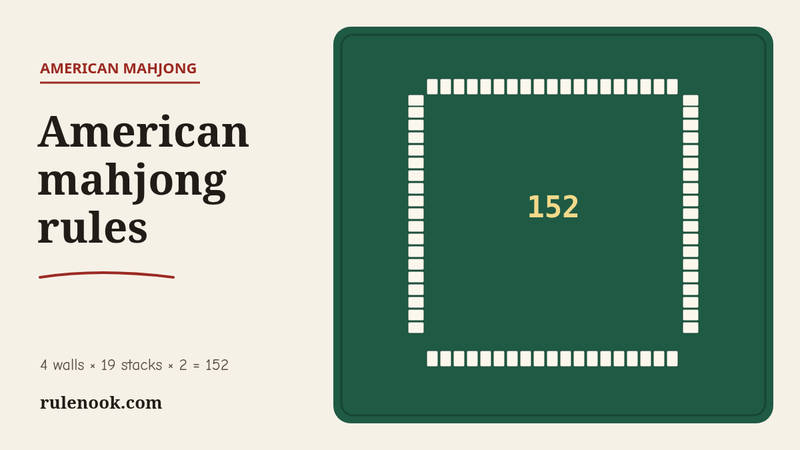
Each player builds a wall of 19 stacks, 2 tiles high, in front of the rack, which gives 38 tiles per wall and 152 on the table once all 4 walls are up. East rolls the dice and breaks the wall at that count.
- Players take 4 tiles at a time, in turn, until each holds 12.
- Each player takes 1 more tile. East takes 1 extra.
- East now holds 14 tiles. Everyone else holds 13.
East starts the play by discarding. No draw. After each game the deal moves one seat to the right.
How does the Charleston work?
Before the first discard, everyone passes unwanted tiles in a fixed order. Passes are always 3 tiles, and you may never pass a joker.
| Stage | Direction of each pass | Required? |
|---|---|---|
| First Charleston | Right, across, left | Yes |
| Second Charleston | Left, across, right | Optional; any one player can stop it |
| Courtesy pass | Across only, 0 to 3 tiles | Optional; you and the player opposite agree on the number |
On the last pass of each Charleston (first left, second right) you may "blind pass": send on 1, 2 or 3 of the tiles you were just handed, unseen. Our Charleston page walks through all 7 passes with a sample hand.
What happens on each turn?
Play moves to the right, counterclockwise around the table. On your turn you take the next tile from the wall and then discard 1 tile face up, naming it out loud ("3 bam") so that the whole table hears the same tile you meant to throw. Back to 13 tiles.
You can also take the latest discard out of turn. Only two reasons count:
- To expose a group. You need the discard to finish a pung (3 alike), kong (4), quint (5) or sextet (6) that your hand needs. Place the group face up on your rack, then discard.
- To declare Mah Jongg. This is the only time you may claim a discard for a single tile or a pair.
You must call before the next player has drawn and racked a tile. If two players want the same discard, a call for Mah Jongg wins. Between two players who want it for an exposure, the one next in turn takes it. Play then continues to the right of whoever called, so some players lose a turn.
Official rule vs house rule. In the rule book a called group must be exposed right away, all of it. Some tables let a player hold the called tile and expose later. That's a house rule; agree on it before the first deal.
How do jokers work?
Jokers stand in for any tile in a group of 3 or more. Never in a single. Never in a pair. If a joker sits in someone's exposure and you hold the real tile it stands for, you may swap on your turn and take the joker. You can do this with your own exposures too.
The finer points, including discarded jokers and an all-joker group, are on our jokers page.
How do you read the NMJL card?
We don't reprint any hands from the card, because the League owns that content and publishes a new card every spring with different lines and values. What we can explain is how the notation works, so the card makes sense when you open it.
| On the card | What it means |
|---|---|
| Section heading | A family of hands, such as even numbers or consecutive runs |
| Colors in a line | Each color is a different suit. One color means one suit; three colors mean three suits |
| A digit repeated (e.g. 3 of the same digit) | That many tiles of that number: 3 is a pung, 4 a kong |
| F, N, E, W, S, D | Flower, the 4 winds, a dragon |
| 0 | The white dragon used as a zero |
| X or C after the line | X: you may call discards for groups. C: concealed, so you may call only the last tile, for Mah Jongg |
| Number at the end | The value of the hand |
The colors on the card are a code, not a suit. A green group can be played in any suit, as long as groups printed in different colors end up in different suits.
How do you win and how is it scored?
When your 14 tiles match a card line, say "Mah Jongg" and lay the full hand face up. The other players check it against the card. Nobody touches the tiles until they agree.
Scoring uses the value printed next to the line. The rule book sets who pays and how much.
| How you won | Player who discarded | Each other player |
|---|---|---|
| On a discard | 2 x hand value | 1 x hand value |
| Self-drawn from the wall | (no discarder) | 2 x hand value each |
| Jokerless hand (not a singles-and-pairs hand) | Doubles again | Doubles again |
Worked example 1. You win on a discard with a hand valued at 25. The discarder owes 50. The other 2 players owe 25 each, so you collect 100.
Worked example 2. You draw your own winning tile for a 30-point hand. All 3 players owe 60, so you collect 180. If that hand also had no jokers, each payment doubles to 120, for 360 in total.
Groups that play for points rather than coins can keep a running tally on paper. Same arithmetic.
How does a game end?
A game ends when someone declares a valid Mah Jongg. If the last tile of the wall is drawn and discarded with no winner, it's a "wall game": nobody scores, the tiles are mixed, and the deal passes to the right.
A player whose hand becomes dead stops drawing and discarding but stays at the table. Common causes are holding the wrong number of tiles and making an exposure that no line on the card can use. If someone else then wins, the dead player still pays.
Common Rules Questions
Which American mahjong hand is easiest for a beginner?
Look for lines marked X that are built from pungs and kongs. Jokers can fill any group of 3 or more, so those hands accept the most help. Avoid concealed (C) lines and the singles-and-pairs section at first. Jokers can't touch singles or pairs, so those hands need every exact tile. The card changes each year, so check this spring's card rather than last year's advice.
What are the most common beginner mistakes at the table?
Three errors cause most dead hands. First, exposing a group that no card line can use. Second, miscounting tiles after a call and ending up with 12 or 14 on someone else's turn. Third, calling a discard for a pair when you aren't going out. Count your rack after every call, because 13 tiles plus your exposures is the only legal total between turns.
Is American mahjong hard to learn?
The turn itself is short: draw, discard, and sometimes call. Most new players learn that in one session. The slow part is the card. You need to scan dozens of lines and pick 2 or 3 targets after the Charleston. Expect several sessions before you can read the card quickly, and use 3-player games with the card open on the table as low-pressure practice while you learn the sections.
Where can you find the official American mahjong rules?
The NMJL does. Its rule book is Mah Jongg Made Easy, and its annual card lists every legal hand for that year. Both are sold by the League. Club rules and online guides, including this one, summarize the book. When a guide and the book disagree? The book wins. Write down any house rules your group adds so new players see them.
What happens when your hand is declared dead?
Official rule: you stop playing that game. You no longer draw, discard or call, but you keep your tiles and your seat. The other players carry on. If one of them wins, you pay like any other non-discarder. If the wall runs out, nobody pays. Common house rule: some groups let a dead player keep picking to keep the turn order simple. Settle that before play.
What house rules do groups add?
The most common ones are a "blanks" game that lets you trade a blank tile for a discard, a set penalty for a false Mah Jongg, and a minimum value for a winning hand. None of these appear in the League's rule book. A table rule only works if everyone agrees on every detail before the first deal, including the penalties.
What to read next
- The Charleston, pass by pass
- Jokers in American mahjong
- Mahjong tiles explained: 136, 144, 152 and 166
- How to choose a mahjong set
- All mahjong rules
Sources: National Mah Jongg League, Mah Jongg Made Easy (current edition): deal, Charleston, calling, joker and payment rules. The NMJL annual card is described by structure only; no hands are reproduced. Last updated 2026-10-10.
Sources
- National Mah Jongg League, Mah Jongg Made Easy (current edition)
- NMJL annual card (structure only, no hands reproduced)