How to Play Mahjong (Chinese / Hong Kong Style) for Beginners
To win at Chinese or Hong Kong mahjong, you collect 4 sets and 1 pair: 14 tiles in all. Four players draw and discard from a 144-tile wall, and you can claim other players' discards to finish sets.
This page covers the Hong Kong (Cantonese) game, which is what most home tables outside Japan and the US play. If your group uses jokers and a yearly card, read American mahjong rules instead. There is no single governing body for Hong Kong mahjong, so where tables commonly differ we say so and label the house rule.
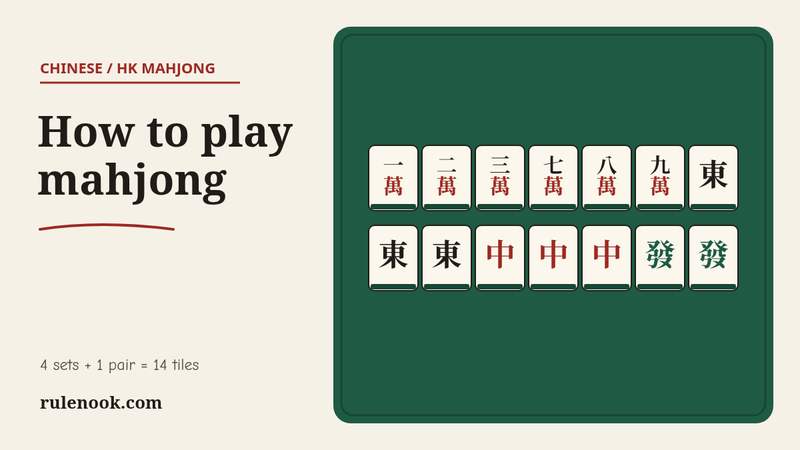
What tiles are in a Chinese mahjong set?
| Tiles | Ranks | Copies | Total |
|---|---|---|---|
| Dots (circles) | 1 to 9 | 4 each | 36 |
| Bamboo (bams) | 1 to 9 | 4 each | 36 |
| Characters (craks) | 1 to 9 | 4 each | 36 |
| Winds | East, South, West, North | 4 each | 16 |
| Dragons | Red, green, white | 4 each | 12 |
| Flowers and seasons | 4 + 4 | 1 each | 8 |
| Total | 144 |
Leave the 8 flowers out and you have 136 tiles, which some groups prefer. Our tile count page breaks down the 136, 144, 152 and 166 versions.
You don't need racks or jokers for this game. If you're shopping, the set buying guide shows how to tell a 144-tile Chinese set from an American one.
What counts as a set?
| Set | What it is | Example | Can you claim a discard for it? |
|---|---|---|---|
| Chow | 3 in a row, same suit | 4-5-6 of bamboo | Only from the player on your left |
| Pung | 3 identical tiles | 3 red dragons | From any player |
| Kong | 4 identical tiles | 4 East winds | From any player; draw a replacement tile |
| Pair (the "eyes") | 2 identical tiles | 2 of 9 dots | Only when it completes your win |
Honors (winds and dragons) can form pungs and kongs but never chows. No wrapping, either: 8-9-1 isn't a chow.
How do you set up and deal?
- Mix the tiles face down. Each player builds a wall of 18 stacks, 2 tiles high (17 stacks with a 136-tile set).
- Roll dice to pick the first dealer, who sits East. The dealer rolls again to choose where the wall is broken.
- Take tiles 4 at a time until everyone has 12. Then each player takes 1 more and the dealer takes 1 extra.
- The dealer holds 14 tiles. Everyone else holds 13.
- Set any flowers face up beside you and draw replacements from the far end of the wall.
What happens on each turn?
The dealer opens by discarding 1 tile. Then play moves counterclockwise.
On your turn, draw 1 tile from the wall, then discard 1 face up into the middle. Your hand returns to 13 tiles. If you hold 4 of a kind, you may declare a kong, lay it down and draw a replacement from the back of the wall.
Between turns, any player can call the last discard:
- "Pung" or "kong": take the discard from anyone and expose the set.
- "Chow": take the discard only if it came from the player on your left.
- "Hu" (or "mahjong"): take the discard to complete a winning hand.
When two calls collide, a win beats a pung or kong, and a pung or kong beats a chow. If two players both call a win, the one next in turn after the discarder takes it (some tables allow both to win). After a pung or kong call, play continues from the caller, so players in between lose their turn.
How do you know your hand is a win?
Run these 5 checks before you call. A false win costs you.
- Tile count. 14 tiles, counting each kong as 3. Flowers sit outside the count.
- Shape. Exactly 4 sets and 1 pair.
- Each set is legal. Chows in one suit and in order; pungs and kongs identical.
- Claimed tile. If you won on a discard, it completes one set or the pair.
- Minimum value. Many tables require a minimum score, often 3 faan. Check your table's number before play.
Worked check. Hand: 2-3-4 bamboo, 7-7-7 dots, 5-6-7 characters, 3 East winds, and a pair of 9 dots. Sets: 2 chows plus 2 pungs, which makes 4. Pair: 9 dots. Tiles: 3 + 3 + 3 + 3 + 2 = 14. It passes checks 1 to 4. Whether it clears a 3-faan minimum depends on the seat and round winds, which is covered on our mahjong scoring page.
One special hand ignores the 4-sets shape: thirteen orphans, one of each 1 and 9 in all 3 suits, each wind and each dragon, plus a duplicate of any of them. Seven pairs is a winning hand in Chinese Official rules and in many modern home rule sheets, but traditional Hong Kong play doesn't accept it at all, even as a minimum-value hand with no other scoring elements. Ask first.
How does a hand end, and who deals next?
A hand ends when someone wins or when the wall runs out with no winner, which is a draw and scores nothing. In Hong Kong play the dealer keeps the deal after a win and, at most tables, after a draw. Otherwise the deal passes to the right, to South.
A full game is 4 rounds named for the winds, East round first. Each round lasts at least 4 hands, so a full game runs at least 16 hands. Plenty of home groups simply play a fixed number of hands instead.
How is it different from American mahjong?
| Hong Kong / Chinese | American (NMJL) | |
|---|---|---|
| Tiles | 144 (or 136) | 152, including 8 jokers |
| Winning hand | Any 4 sets + 1 pair | Must match a line on this year's card |
| Chows (runs like 4-5-6) | Yes | No |
| Tile passing before play | None | The Charleston, 3 to 7 passes |
| Calling a discard for a pair | Only to win | Only to win |
| Racks | Optional | Expected, 1 per player |
The core difference sits in row 2. The American game fixes the target hand before you start, while the Hong Kong game lets you build any legal shape and only scores it once you have won.
Common Rules Questions
What is the simplest version of mahjong to start with?
Start with Hong Kong rules and a minimum of 0 faan, so any 4 sets and a pair wins. Play with all 144 tiles but treat flowers as simple bonus tiles worth 1 point each, or leave them out. Skip special hands for the first few sessions. Once winning hands come naturally, add a 3-faan minimum, which pushes you toward pungs, honors and one-suit hands.
Can you win by robbing a kong?
Yes, at most tables. If a player adds a fourth tile to an exposed pung and that tile completes your hand, you may claim it and win. The tile is treated as if it were discarded by the player who tried to make the kong. You can't rob a concealed kong, except at tables that allow it for thirteen orphans. Agree on that edge case before you play.
What happens if you declare a win by mistake?
There's no universal rule, so set one before play. Official Chinese (MCR) rules fine the false caller and play continues. In Hong Kong home games the common penalty is paying every other player as if they had won a modest hand, then redealing. The player whose hand was exposed by mistake should not keep playing it.
Do flower tiles count toward your 14 tiles?
No. Flowers and seasons are bonus tiles. You set each one aside as soon as you draw it and take a replacement from the back of the wall, so they never sit in your 13 or 14. They can add points, especially your own seat's flower, but a winning hand still needs 4 sets and a pair without them.
What to read next
- How to set up mahjong: building the wall
- How to score mahjong
- Mahjong for 2 or 3 players
- How to choose a mahjong set
- All mahjong rules
Sources: Hong Kong mahjong as commonly published (no single governing rule book; table variations labeled above); Chinese Official (MCR) rules used only for the seven-pairs and false-win comparisons. Last updated 2026-10-10.
Sources
- Hong Kong (Cantonese) mahjong as commonly published; no single governing rule book
- Chinese Official (MCR) rules for comparison points only