How to Score Mahjong: American Payments and Hong Kong Faan, With Worked Examples
Mahjong scoring depends on the style. In American (NMJL) mahjong, each hand on the card has a printed value. The player who discarded the winning tile pays double and the other 2 pay the value once. In Hong Kong mahjong, you count faan (doubles) for what's in the hand, then convert faan to points on a table that doubles with every faan.
Only the winner scores in both styles. Losers never add up the tiles left in their own racks, which surprises players who come to mahjong from rummy.
How does American mahjong scoring work?
Every line on the NMJL card has a value printed beside it, usually 25 to 50 points. We don't reproduce the card, so the examples below use a made-up value of 25, which is enough to show how each payment rule works.
| How the hand was won | Discarder pays | Each other player pays |
|---|---|---|
| On a discard | 2 x value | 1 x value |
| Self-drawn from the wall | (no discarder) | 2 x value |
| Jokerless, on a discard | 4 x value | 2 x value |
| Jokerless, self-drawn | (no discarder) | 4 x value |
Jokerless means no jokers anywhere in the 14 tiles. None. Hands from the singles-and-pairs section can't use jokers at all, so the League gives them no jokerless bonus.
Worked example 1: won on a discard
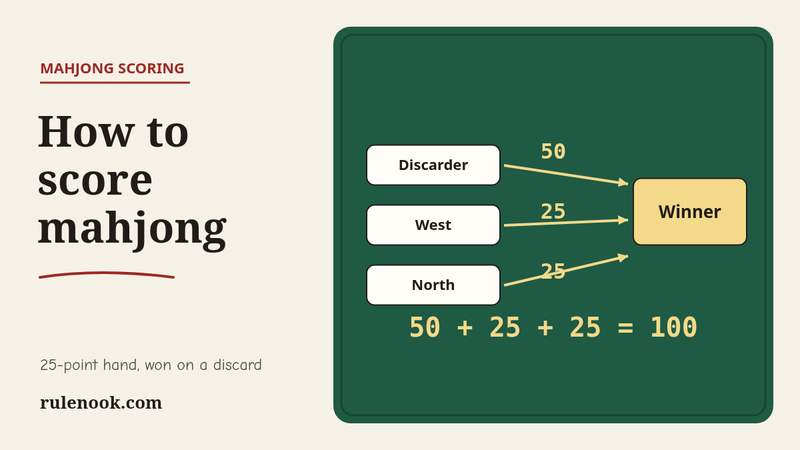
South throws the winning tile for a 25-point hand. South pays 50 and West and North pay 25 each, so you collect 50 + 25 + 25 = 100.
Worked example 2: self-drawn and jokerless
The same 25-point hand, drawn from the wall with no jokers in it. Each of the 3 other players pays 25 x 2 x 2 = 100, for a total of 300.
If the wall runs out, nobody pays. If a player calls Mah Jongg in error and exposes the hand, the League's book has penalties; check your copy rather than inventing one at the table.
How does Hong Kong mahjong scoring work?
Two steps. Count the faan in the winning hand, then look up what those faan are worth in points.
There's no single official Hong Kong rule book. The values below are the ones most often printed for Hong Kong "new style" play, and many tables change a few of them. Agree on your table's list before the first hand.
Typical faan values (tables vary)
| What's in the hand | Faan |
|---|---|
| Common hand: every set is a chow (run) | 1 |
| All pungs: every set is a pung or kong | 3 |
| Mixed one suit: one suit plus honors | 3 |
| All one suit, no honors | 7 |
| Each pung of dragons | 1 |
| Pung of your seat wind | 1 |
| Pung of the round wind | 1 |
| No flowers or seasons | 1 |
| Your own flower or season (each) | 1 |
| Self-drawn winning tile | 1 |
| Fully concealed hand | 1 |
| Win on the last tile of the wall | 1 |
| Limit hands such as Thirteen Orphans | 10 to 13 (cap) |
Most tables require a minimum of 3 faan to declare a win. Not all. A hand worth 0 faan is called a chicken hand, and some family groups allow it as a win anyway.
From faan to points
| Faan | Points (full doubling) | Points (half doubling) |
|---|---|---|
| 0 | 1 | 1 |
| 1 | 2 | 2 |
| 2 | 4 | 4 |
| 3 | 8 | 8 |
| 4 | 16 | 16 |
| 5 | 32 | 24 |
| 6 | 64 | 32 |
| 7 | 128 | 48 |
| 8 | 256 | 64 |
| 10 | 1,024 | 128 |
| 13 | 8,192 | 384 |
Full doubling is 2 to the power of the faan, while half doubling slows the climb from 4 faan on by doubling only every second faan. Simple. Many tables also cap the count at 8 or 10 faan, so a 12-faan hand is paid as 10.
Who pays in Hong Kong play?
In one common scheme, the discarder pays the full table value alone, and on a self-drawn win each of the other 3 players pays half of it. Fair split. Another scheme, "discarder pays half," splits a discard win between the discarder and the other 2 players. Pick one before you start, and write it on the score sheet so nobody has to remember it at 11 pm.
Worked example 3: won on a discard
Four chows and a pair. Nothing exposed. No flowers. Common hand 1, no flowers 1 and concealed 1 make 3 faan, worth 8 points, and the discarder pays all 8.
Worked example 4: self-drawn
Three pungs in Bamboos (one of them exposed), a pung of Red Dragons, a pair of 2 Dots, and 1 flower that isn't your seat's. All pungs 3, Red Dragon 1, self-drawn 1: 5 faan, or 32 points full doubling. Each player pays 16, so you collect 48.
Common Rules Questions
How is a self-drawn, jokerless Mah Jongg paid?
Official American rule: self-drawn means all 3 players pay double the hand's value, and jokerless doubles each payment again. So each player pays 4 times the value. On a 25-point hand that's 100 from each of the 3 players, 300 in all. The exception is a singles-and-pairs hand, which can't use jokers and so earns no jokerless bonus.
What is the minimum faan to win in Hong Kong mahjong?
Most Hong Kong tables set it at 3 faan, which pushes players to build hands instead of grabbing the first win available. It isn't fixed. Family games often play with 0 or 1, and some tournaments use other limits. Whatever you choose, write it down, because a claimed win under the minimum is usually treated as a false Mah Jongg with a penalty.
Do flowers count in Hong Kong scoring?
Yes, in the typical table. Your own seat's flower or season scores 1 faan each, and drawing no flowers at all scores 1. A full set of 4 flowers or 4 seasons usually scores 2. Flowers never count toward the 4 sets and a pair, though; they sit beside your rack and only add faan once the hand has already won on its own.
What to read next
- American mahjong rules
- How to play Chinese and Hong Kong mahjong
- Jokers in American mahjong
- Mahjong racks, pushers and accessories
- All mahjong rules
Sources: National Mah Jongg League, Mah Jongg Made Easy: who pays and the jokerless and self-drawn doubles, as summarized by secondary sources and not checked against the book itself; no card hands or values are reproduced. Hong Kong faan values and both points tables: Wikipedia, "Hong Kong mahjong scoring rules" (read 2026-10-10), labeled typical. Every payment above is rechecked by script, see our methodology. Last updated 2026-10-10.
Sources
- National Mah Jongg League, Mah Jongg Made Easy (payments, via secondary summaries)
- Wikipedia, Hong Kong mahjong scoring rules (faan values and faan-to-points tables, read 2026-10-10)