How to Set Up Mahjong: Walls, Dice, Breaking the Wall and the Deal
To set up mahjong, mix the tiles face down, build 4 walls 2 tiles high, roll the dice to find where the wall opens, and deal 13 tiles to each player and 14 to the dealer. The only number that changes between styles is the wall length: 19 stacks for American, 18 for Chinese and Hong Kong.
Below is the order of operations, with a count you can check at each step. Expect about 5 minutes. Less with practice.
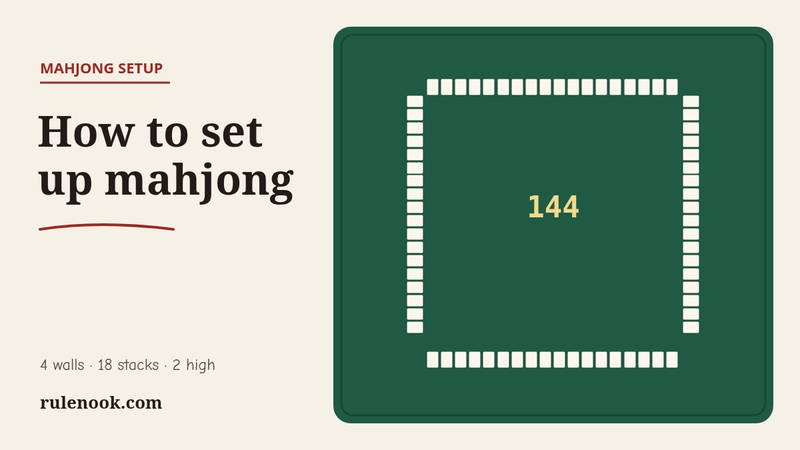
How many tiles go in each wall?
| Style | Tiles in play | Stacks per wall | Tiles per wall | Check |
|---|---|---|---|---|
| American (NMJL) | 152 | 19 | 38 | 4 x 38 = 152 |
| Chinese / Hong Kong with flowers | 144 | 18 | 36 | 4 x 36 = 144 |
| Chinese without flowers | 136 | 17 | 34 | 4 x 34 = 136 |
Put spare tiles back in the box before you build. Many American sets hold 166 tiles, and 14 of them (8 spare flowers, 2 extra jokers, 4 blanks) don't belong on the table. Our tile count page lists what stays in for each style, category by category, so you can sort the box once and keep the spares in their own bag for the next game.
What order do you set up in?
- Pick seats and the first dealer: Roll the dice. High roller is East and deals.
- Shuffle: Turn every tile face down and mix with both hands for 20 to 30 seconds; all 4 players can help.
- Build: Each player builds one wall in front of their own seat: a row of stacks 2 tiles high, as long as the table above says.
- Push: The 4 walls meet at the corners to form a square, and racks with pushers do this in one move.
- Roll and break: The dealer rolls to choose where the wall opens.
- Deal: Players take tiles in blocks of 4, then singles, until everyone has 13 and the dealer has 14.
Count check before you deal: Count one wall first. If it has 19 stacks in an American game, or 18 in a Hong Kong game, the other 3 usually match. Short wall? Check the box.
How do you break the wall?
The dice choose the gap: the dealer rolls, counts that many stacks along a wall, and pulls the tiles apart there. Dealing starts at the gap and works clockwise around the square, while replacement tiles come from the other side of it.
American (NMJL): East rolls 2 dice and counts that many stacks along East's own wall, then separates the wall at that point. With a roll of 7, the gap falls after the 7th stack.
Hong Kong: Tables differ more here. In one common method the dealer rolls 3 dice and counts the total counterclockwise around the seats, starting with the dealer as 1, to pick the wall. Then the dealer counts that many stacks in from the end of that wall. A roll of 10 lands on South's wall (East 1, South 2, West 3, North 4, East 5, and so on to 10).
House rule: Some groups skip the dice and always break East's wall at the same spot. Fair enough, if the mix was good.
How do you deal the tiles?
Both styles use the same pattern.
| Round | Each player takes | Running total |
|---|---|---|
| 1 | 4 tiles | 4 |
| 2 | 4 tiles | 8 |
| 3 | 4 tiles | 12 |
| 4 | 1 tile; dealer takes 1 extra | 13, dealer 14 |
Dealer first, every round. Total dealt to 4 players is 13 x 3 + 14 = 53 tiles, which leaves 99 in an American wall and 91 in a 144-tile Hong Kong wall when the first discard goes down.
American only: Next comes the Charleston, the tile pass before play, and our Charleston page has every pass. After it, the dealer discards first without drawing.
Hong Kong only: Anyone dealt a flower or season sets it face up and draws a replacement, dealer first, and then the dealer opens with a discard.
How do you set up for 3 players?
American: No tiles come out: all 152 are used, so all 4 walls are built and the 4th is shared. Deal as above to 3 players: 13, 13 and 14 for East. The Charleston is skipped in 3-player games according to the NMJL summaries we have read, so confirm this with your copy of the book.
Hong Kong: Most tables remove one suit, usually characters 2 to 8, which takes out 28 tiles and turns a 144-tile set into 116. Build 4 shorter walls or 3 longer ones. Either works. Our 2- and 3-player page covers the rules that change.
Common Rules Questions
Which way do you take tiles from the broken wall?
Clockwise, from the gap. In both American and Hong Kong play the dealer takes the first block of 2 stacks (4 tiles), and the deal continues around the walls from there. Play and discards go the other way, counterclockwise. Replacement tiles for kongs and flowers come from the far side of the gap, so the two never collide until the wall is almost gone.
Do you need dice to play mahjong?
No rule depends on the exact roll, because the dice only pick a random spot to break the wall and, at some tables, the first dealer. If a set arrives without dice, any 2 standard dice from another game work, and some groups skip them entirely and break the wall at a fixed point after a thorough face-down mix. Agree first.
What if the walls don't come out even?
Count each wall; a 152-tile game needs 4 walls of 19 stacks, and a 144-tile game needs 4 of 18. One stack short? A tile is missing. Rebuild before you deal; playing on with 151 tiles changes how long the game lasts and can strand someone at 12 tiles.
What to read next
- How to play Chinese and Hong Kong mahjong
- Mahjong tiles explained: 136, 144, 152 and 166
- Mahjong racks, pushers and accessories
- All mahjong rules
Sources: National Mah Jongg League, Mah Jongg Made Easy (American walls, break and deal, as summarized by Tom Sloper's Mah-Jongg FAQ 13 and the League's Q&A; not checked against the book itself). Hong Kong dice convention: common practice, varies by table. Tile arithmetic is ours. Last updated 2026-10-10.
Sources
- National Mah Jongg League, Mah Jongg Made Easy (American setup, via secondary summaries)
- Tom Sloper, Mah-Jongg FAQ 13 (3-player American play)
- Wikipedia, Hong Kong mahjong scoring rules (dealer conventions, read 2026-10-10)